
Easton City Directory Holdings by Era
Easton does not have one known, uninterrupted shelf of annual directories. Instead, the strongest starting points are a verified 1889 publication, selected State Library years, and local collections that supply names between directory dates. The Town's historic-district report identifies the 1889 Resident and Business Directory for Easton, Mass., published by Local Directory Publishing Co. of Needham. The State Library separately lists Easton city directories from 1889 to 1942 in selected years. Neither source supports a claim of a complete, year-by-year business run.
| Easton source | Documented period | Where to start | Access notes |
|---|---|---|---|
| Resident and Business Directory | 1889 | Town historic-district report | Publication title and publisher verified; inspect a page before relying on entry details. |
| State Library city directories | 1889 to 1942, selected years | Massachusetts State Library holdings | Exact selected years and call numbers need confirmation. |
| Poll and real-estate tax books | 1853 to 1960 | Easton Historical Society | Staff-mediated historical holding, not a city-directory series. |
| Newspapers and local history | Multiple documented runs | Ames Free Library and Stonehill | Useful for dated notices, household context, and missing directory years. |
The Easton historic-district report is the best local citation for the 1889 title and related collections. The State Library holdings list is a discovery tool, not a substitute for confirming a particular volume is available when you visit for Easton research.
Note: A missing year can mean the directory was not located, not that an Easton household was absent.
Easton's 1889 Resident and Business Directory
The 1889 Easton title is a valuable fixed point because its full name, publisher, and place of publication are documented locally. It can support a search for a person, firm, village, or street reference from that year. It does not establish that every Easton resident or business was included. A historical listing can be dated, incomplete, or use a village description that differs from a later mailing label.
Before copying details from an Easton directory, record the volume title, page header, publication year, surname spelling, and page number. Then compare the finding with an Easton census, newspaper notice, tax book, deed, or cemetery record when the question matters. An owner named in a land record and a name printed in a directory can refer to different address roles, so each source should keep its own meaning.
Easton State Library Directory Years
The Massachusetts State Library identifies Easton city directories for 1889 through 1942 in selected years. That wording matters. The inspected holdings document did not expose a complete list of individual years, shelf locations, or whether each volume has the same format. Ask staff for the selected-year list before planning a comparison across a decade. This is especially important when a person appears to vanish between two dates.
Use the directory title, a surname variant, and a date range when asking for help. If a year is not held, work outward with Easton newspapers, town reports, local tax books, and census schedules instead of assuming a continuous directory exists. The historical evidence supports a carefully dated trail, not a blanket claim about every Easton household.
State Library listings are a way to locate potential Easton volumes, not a promise that the selected years form an even sequence. Preserve the exact year on every Easton note. That simple habit prevents a comparison from turning a gap in holdings into a claim that an Easton person, family, or business left town.
Easton Research at Ames Free Library
Ames Free Library's research page directs Easton researchers to local history, genealogy, newspapers, and more than 60 databases. At 53 Main Street, the library lists phone service at 508-238-2000 and hours of Monday through Thursday, 9 to 8; Friday, 9 to 5; Saturday, 10 to 5; and Sunday closed. Call or email before a visit because access needs and staffing can change.
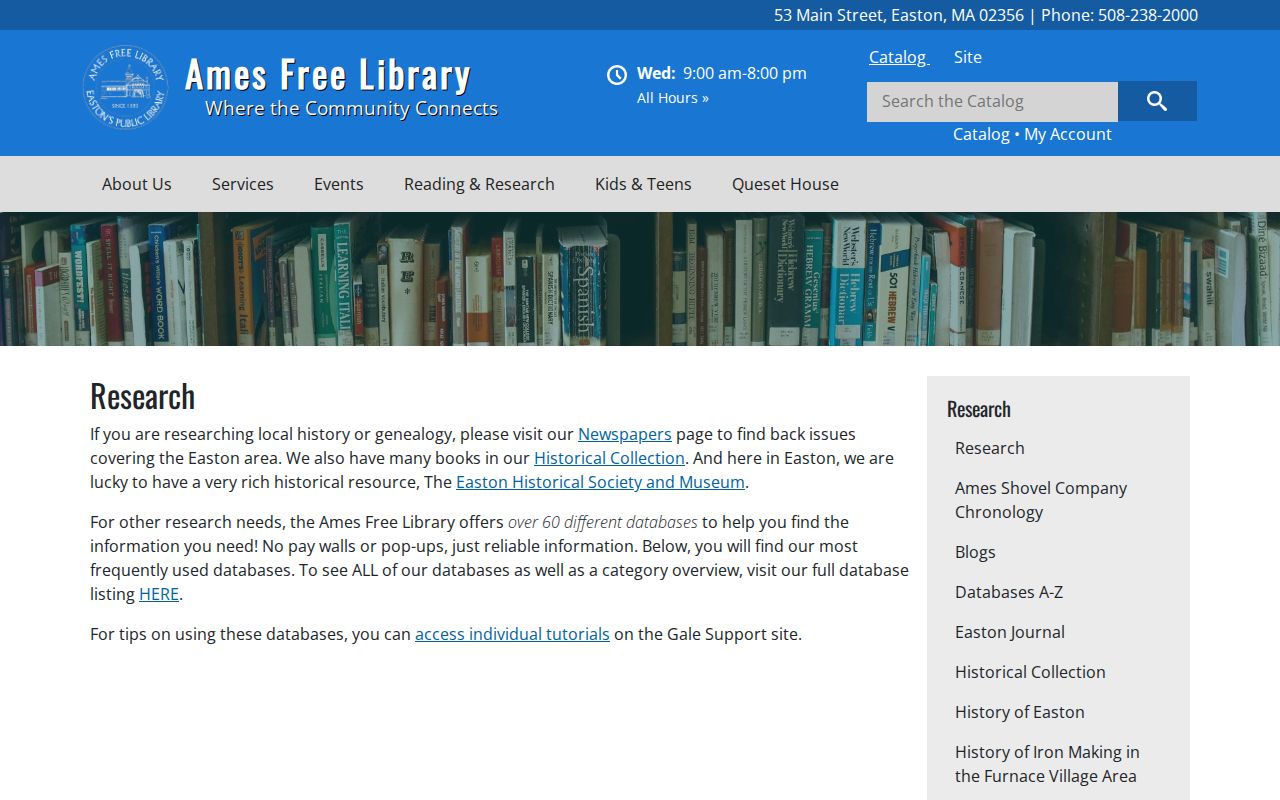
Those research routes are a practical place to combine an Easton directory lead with a newspaper, genealogy reference, or staff question.
Ames Free Library's Historical Collection is in the balcony barrel vault. It is non-circulating and staff-retrieved, so a request for a directory-related item needs to account for that access method rather than assume an open shelf. The collection includes genealogy reference materials and selected historical periodicals that can help interpret an Easton name.
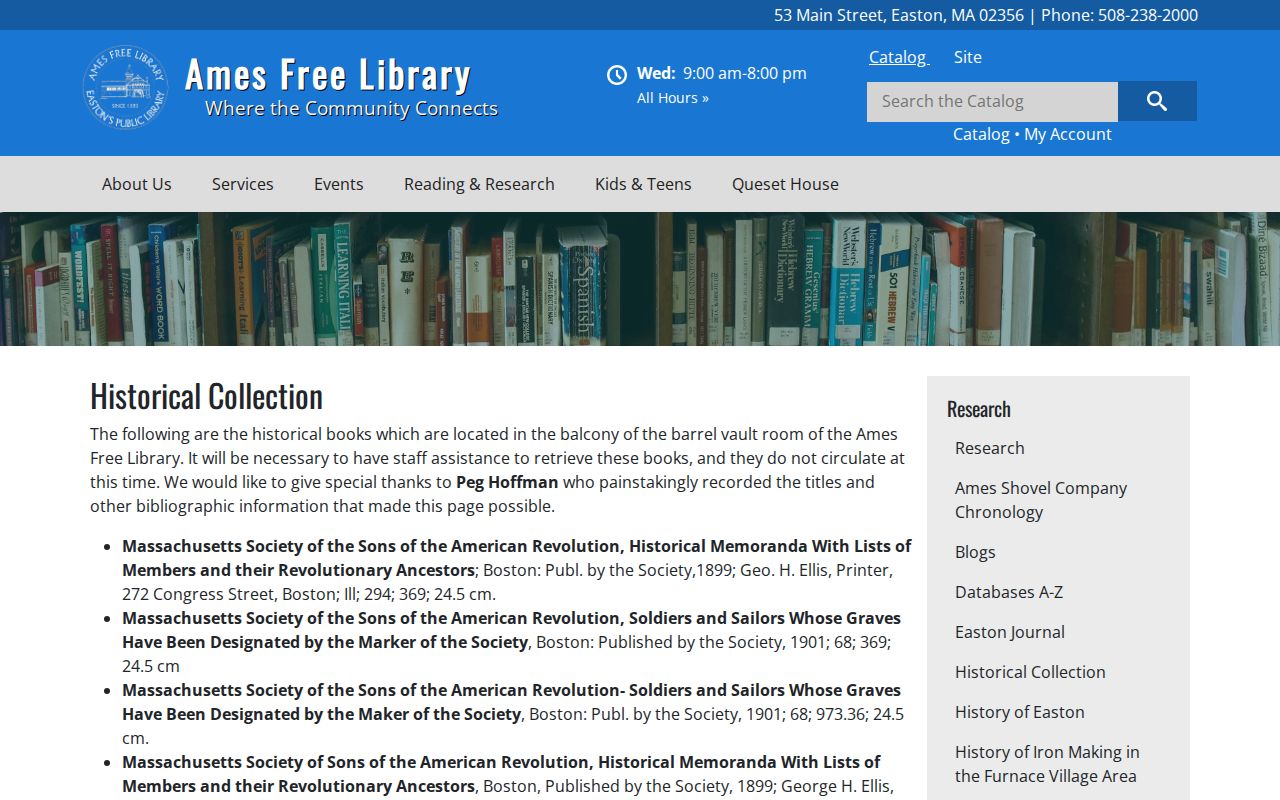
For an Easton visit, staff retrieval makes it sensible to arrive with a surname, approximate period, and the collection or publication you hope to consult.
Easton Directory Gaps in Newspapers
Newspapers can bridge intervals between an Easton city directory year and later evidence. Ames lists physical Easton Journal volumes from January through June 1994 to January through June 2015, while the digital Easton Journal run from July 2015 through December 2018 is available in the library. Its Easton Bulletin holdings include 1931 to 1932, 1949 to 1966, and May to June 1993 through March 1999.
Ames Free Library's newspaper holdings page separates its bound volumes from in-library digital access and points researchers to Brockton Public Library microfilm for older Easton-area newspapers. That distinction helps set expectations before a trip.
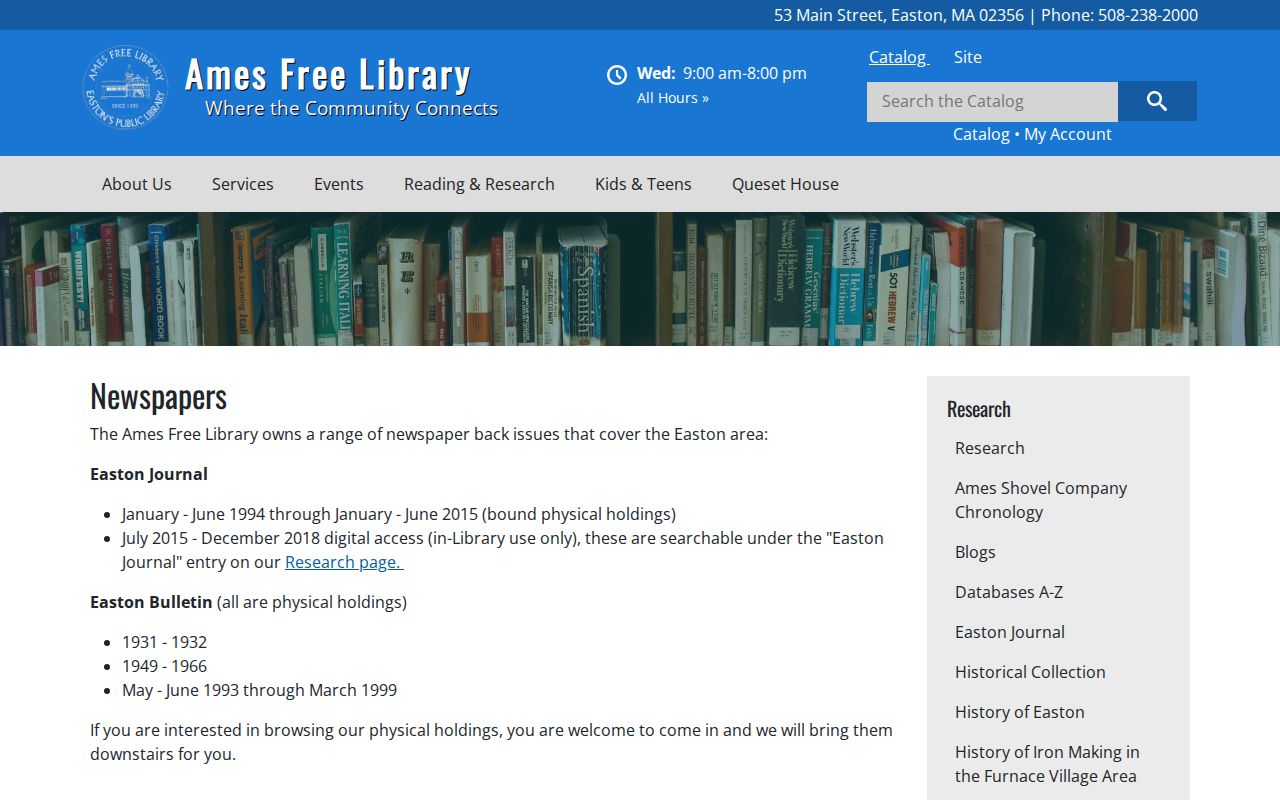
A dated Easton notice, obituary, business mention, or address reference can corroborate a directory lead, but it should still be read as a publication-date source.
Easton Directory Companions at Historical Society
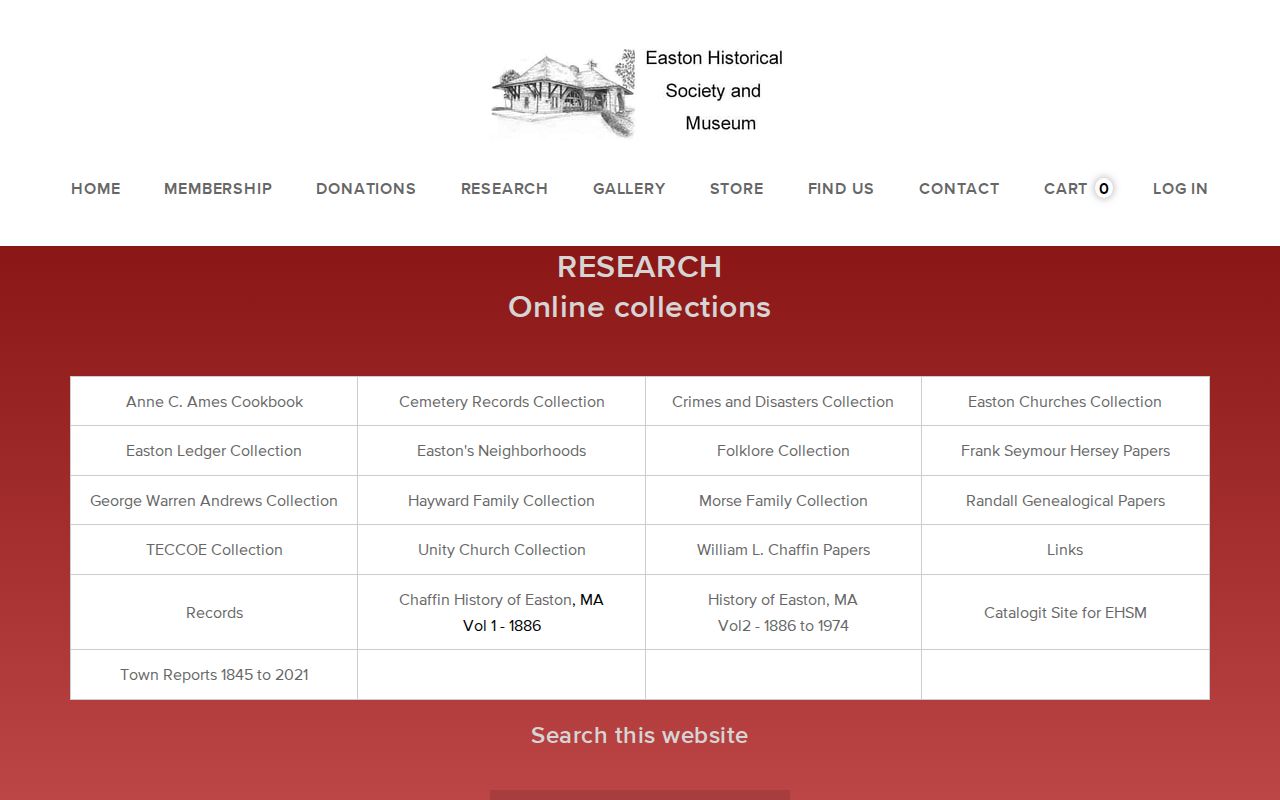
The Easton Historical Society broadens a city-directory search beyond printed volumes. Its research inventory includes family papers, cemetery records, churches, neighborhood materials, businesses, crimes and disasters, the Easton Ledger, and the William L. Chaffin papers. Chaffin's History of Easton spans an 1886 first volume and a second volume covering 1886 to 1974. The Society also links town reports from 1845 to 2021 through Internet Archive.
The Historical Society research page provides a focused inquiry route and lists collections that may need staff assistance. The Society's photo collection is not indexed, but its links page says it can be searched by street, individual, or business. That makes it a useful context source for a dated Easton directory result, not a replacement for the directory itself.
The documented Easton poll and real-estate tax books, covering 1853 to 1960, are another name-and-place trail, though their access is staff-mediated and their fields should be inspected directly.
Reading an Easton Directory With Care
A local entry was not visually inspected, so it would be inaccurate to promise a particular Easton format. Confirm what the individual Easton volume actually prints before treating a name, occupation, address, firm reference, advertisement, or abbreviation as present. A business directory, a resident list, and a classified section can organize information differently. Photograph or note the title page and any legend before transcribing a result.
| Alphabetic entry | Confirm the printed surname, initials, and page context instead of expanding an initial by guesswork. |
|---|---|
| Address or village | Record exactly what appears. Historical Easton village vocabulary can differ from a later postal label. |
| Occupation or firm | Treat it as a dated printed association, then seek an independent record if identity matters. |
| Household or advertiser reference | Verify whether the volume actually uses such a reference before drawing a family or address connection. |
- Householder index
- An alphabetic household listing, if a particular volume provides one. Its presence in an Easton volume was not verified.
- Criss-cross directory
- An address-ordered companion used in some directory systems. Do not assume a selected Easton volume includes one without inspection.
- Abbreviation key
- A publisher's legend, when printed, that should be read from the same volume before expanding any shorthand.
Easton Directory Years With Census
Pairing sources gives an Easton name trail more context. Federal census records are released under the 72-year rule, with 1950 the latest public decennial census as of the research date; the 1890 population schedule is largely destroyed. A census can supply a household snapshot, while an Easton directory can add a listing closer to a particular year. Neither source alone resolves every identity question.
For a structure or address context, the local report identifies Easton Sanborn map years of 1903, 1911, 1925, and 1925 to 1943. The Library of Congress Sanborn collection is the appropriate map discovery route. These maps show structures, materials, uses, and addresses, but the local report cautions that they do not identify building owners.
Easton village names can also appear in older Easton records. North Easton, South Easton, Eastondale, Furnace Village, Unionville, Easton Center, Howard, Bay Road, Poquanticut, and Hayward-Pool are documented historical search terms. Use them as alternate place language, not as proof that a modern boundary or postal label is the same.
Tracing Easton Households Through Directories
A careful Easton city-directory trail moves from one dated entry to another, then checks the spaces between. Begin with the closest known year, preserve the spelling exactly, and note each village or address phrase. Search selected State Library years and Ames materials around that date. If the person is tied to property, compare the dated listing with a deed or tax record without mistaking ownership for occupancy.
- Start with a known Easton surname, business name, village, or approximate year.
- Check the verified 1889 title or a selected State Library volume, recording the exact page and year.
- Use Ames newspapers and Historical Society collections to investigate intervening dates or alternate spellings.
- Pair the result with the applicable census and, where useful, a Sanborn map for address context.
- Keep the source date beside every conclusion and treat unexplained absences as open questions.
The 2025 300 Years, 300 Stories oral-history project adds a different kind of Easton evidence: recorded community voices rather than a formal resident roll. It can add context to a household, neighborhood, or institution, but should be cited as oral history and not as legal proof of an address or title.
Note: A directory disappearance can reflect a move, a missed listing, a changed spelling, or a different publication scope.