
Finding Easton Residents by Record
Easton records are kept by subject, not in one municipal roll. Use the Assessors' property card when an address is known, then use the Northern Bristol County Registry of Deeds to test an ownership trail. For a particular person, a lawful municipal voter-list request, the Massachusetts court docket, or a dated local directory may supply a different kind of confirmation. Owners, applicants, court parties, and people printed in old directories are not automatically current residents. Save the source date and the role shown by each record before drawing a conclusion.
For older Easton research, shift from current parcels toward city directories, poll and tax books, newspapers, census schedules, and deeds. The Town Clerk, Ames Free Library, and Easton Historical Society provide the local fallback when a web search ends. A narrowly described Massachusetts public-records request can ask for an existing record by address, date range, or record type.
- Search an Easton address in the property-card portal and note whether the person is shown as owner, not occupant.
- Use the parcel identifiers and book/page references to check the recorded-land index.
- For an individual status check, use the state voter tool only for the voter whose details and consent are supplied.
- Match historical names to dated directories, newspapers, census, or Historical Society collections.
- Ask the proper custodian for a missing existing record, naming the address, period, and format wanted.
Easton Resident Records Offices
Four offices form the practical Easton residents directory trail. The Assessors tie an owner of record to a parcel. The Registry indexes recorded interests and images. The Town Clerk is the local route for municipal voter material and town-held records. Ames Free Library and the Historical Society preserve the local evidence that modern portals do not cover. For a full address chain, use the Easton street directory method rather than treating a single property-card name as proof of residence.
Massachusetts Elections
Individual voter status
Boston, Massachusetts
1-800-392-6090
Easton Property Cards and Parcels
The Easton property-card portal accepts an owner name, location, MBL, unique identifier, or property-use filter. Its results show street name and number, unit, name, unique ID, MBL, use, acres, zone, and buildings. A linked card can carry assessment, sale, map, GIS, and earlier-owner information. Those fields make it a strong starting point for an Easton residents directory search by address, but they identify an assessment account, not a household.
The Town GIS adds parcel shape, abutters, zoning, and layer context. Search an address, select the black parcel point, and use Layers for zoning or Aquifer Protection District information. Check a map or property-card date before relying on a current display. The state property map is useful when a Massachusetts-wide comparison is needed, but the Easton assessor and Registry remain the local custodians.
Note: A site address is where land sits; a mailing address is where notices go, and the two can differ.
See the Assessor search interface before entering an address.
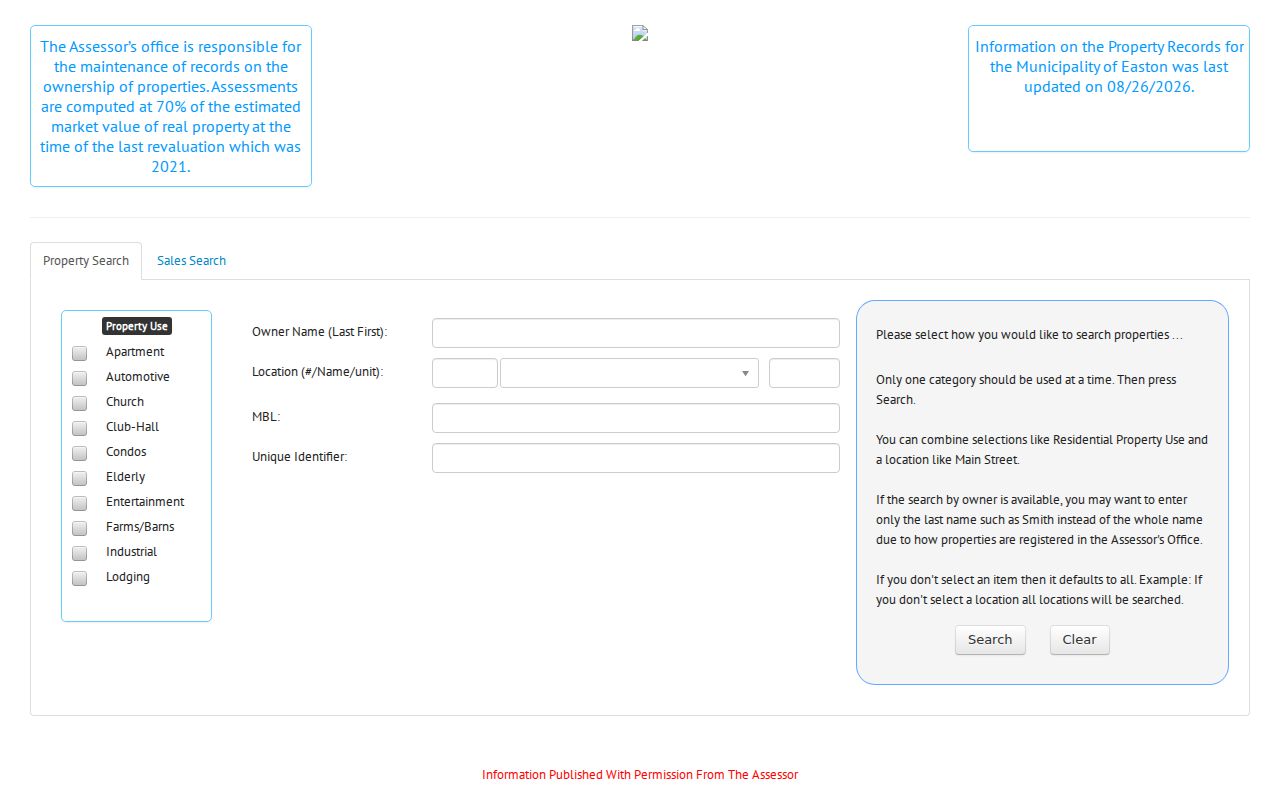
The search controls support an address-led Easton record trail without presenting a public occupant list.
Easton Assessor Search Fields
Use only the fields that narrow the record. A broad name search can mix owners with similar surnames, while a location search works best when the house number, street, and unit are treated as separate controls. The portal says that an owner-name query is normally entered last name first, and blank fields can return a broader set.
| Easton field | Use | Result role |
|---|---|---|
| Owner Name | Last-name-led owner search | Assessment account name |
| Location | House number, street, and unit | Situs-linked parcel |
| MBL / Unique ID | Parcel identifier | Crosswalk to GIS |
| Property Use | Optional class filter | Property category |
When the property card supplies a prior owner or book/page reference, take that exact reference to the Registry instead of guessing which similarly named party belongs to the parcel.
Current Easton Resident Sources
No current Easton residents directory lists every household. The useful current sources each show a narrower role. Keep the role visible in notes, especially when an owner name, a tax recipient, and an applicant differ. The state voter form is an individual status tool requiring first name, last name, date of birth, ZIP, and consent. A municipal list is a distinct Town Clerk route subject to protective exceptions.
| Source | Who It Lists | Keeper | Access |
|---|---|---|---|
| Property cards | Assessed owners and parcel data | Easton Assessors | Free portal |
| Municipal voter list | Dated registered-voter information | Town Clerk | Request, with exceptions |
| Recorded-land index | Parties to instruments | Northern Bristol Registry | Free index |
| PermitEyes | Applicants, owners, and site records | Easton boards | Public portal |
| Community inventory | Local organizations, not households | ECAT | Public page |
For a one-person question, the Easton resident lookup workflow adds the court, vital, and identity checks that an address record cannot supply alone.
Easton Deed Indexes Through Time
The Registry Recorded Land Inquiry advertises index data from April 4, 1735, at Book 24, but the Registry public-records material separately describes images from 1751 and online indices from 1951 to the present. These are different access layers, not interchangeable claims. For older work, use the historical grantor-grantee image books, Registry staff, or an in-person check rather than assuming a modern query is complete.
The online inquiry is free to search and can be narrowed by date, document type, last and first name, grantor/grantee direction, and town. Select Easton, test spelling variants, and search both party directions. Public viewing is free; the Registry reports $1-per-page online printing and office copies. A recorded deed establishes a transaction or interest, not where someone lived.
Note: Historical index books are page images, so early research requires reading the relevant letter range and following book/page references.
Easton Voter Records and Privacy
Massachusetts separates individual voter status from the local voter file. The state status tool is intended for a person checking their own registration. A lawfully obtained Easton municipal list may contain name, address, party, date of birth, active or inactive status, and voter ID information, but protected voters are excluded and the statewide file is not a general public directory. In towns over 5,000, M.G.L. c.51 §55 calls for voting lists arranged by street and numerical address.
Easton’s 2022 reprecincting notice said that 5,329 of 9,901 voting addresses changed. That is an address-history warning, not a current count. Date any voter-list result and do not use a substitute address or protected entry to infer a person’s location.
Review the state voter-lookup form before using personal status information.
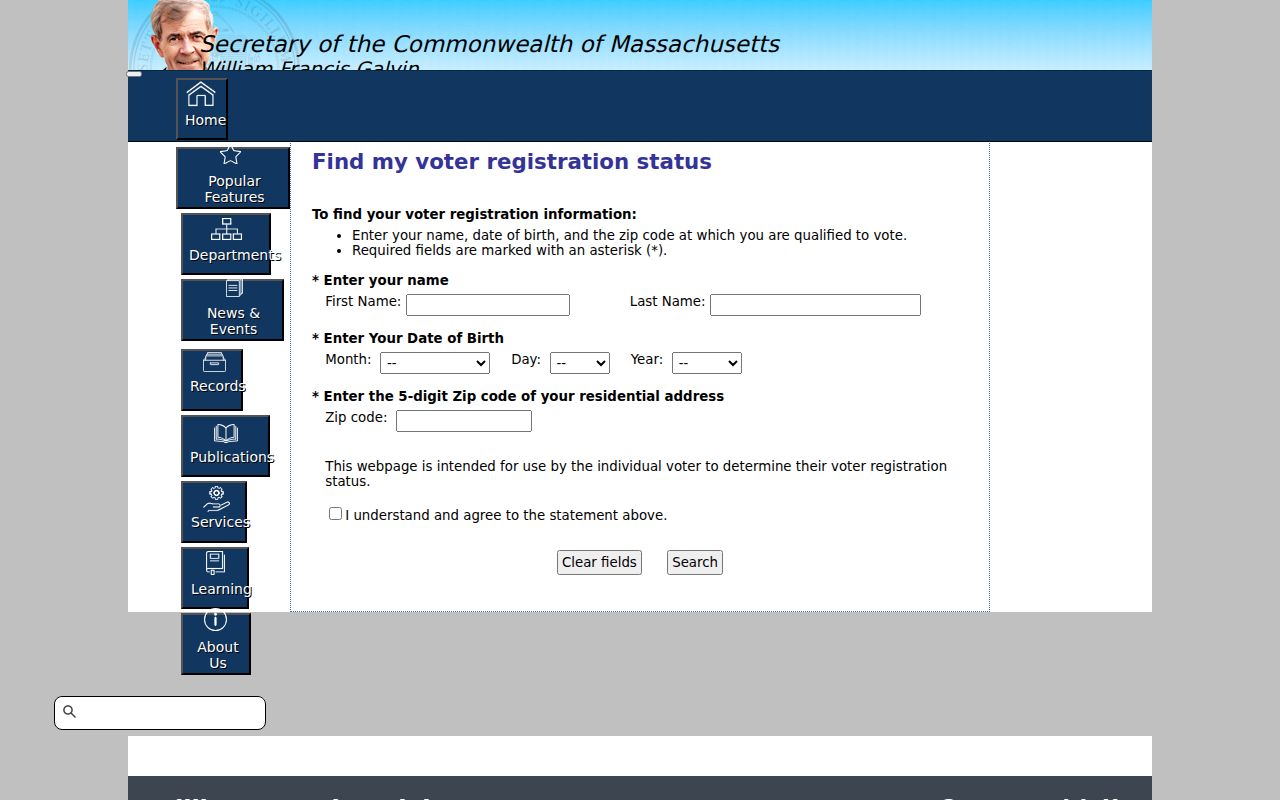
The form’s required identity details and consent checkbox are privacy boundaries, not an invitation to build a name list.
Easton Court and Vital Trails
MassCourts can search a public docket by name, case type, case number, or ticket/citation number. Easton district matters route to Taunton District Court. A result can display party or company, case number and type, file date, party type, status, court, and affiliation, but sealed, impounded, juvenile, and other protected matters may not appear. The clerk holds the official file. For a federal case, PACER has its own registration and fee rules.
Vital records need a separate custody and eligibility check. Massachusetts guidance routes requests through the local town custodian, RVRS, State Archives, and genealogical research channels according to event date and record type. Easton library newspapers, cemetery material, and historical collections can help find a date or relationship, but they do not replace a certified record.
See the Massachusetts docket-search instructions for the current public-search controls.
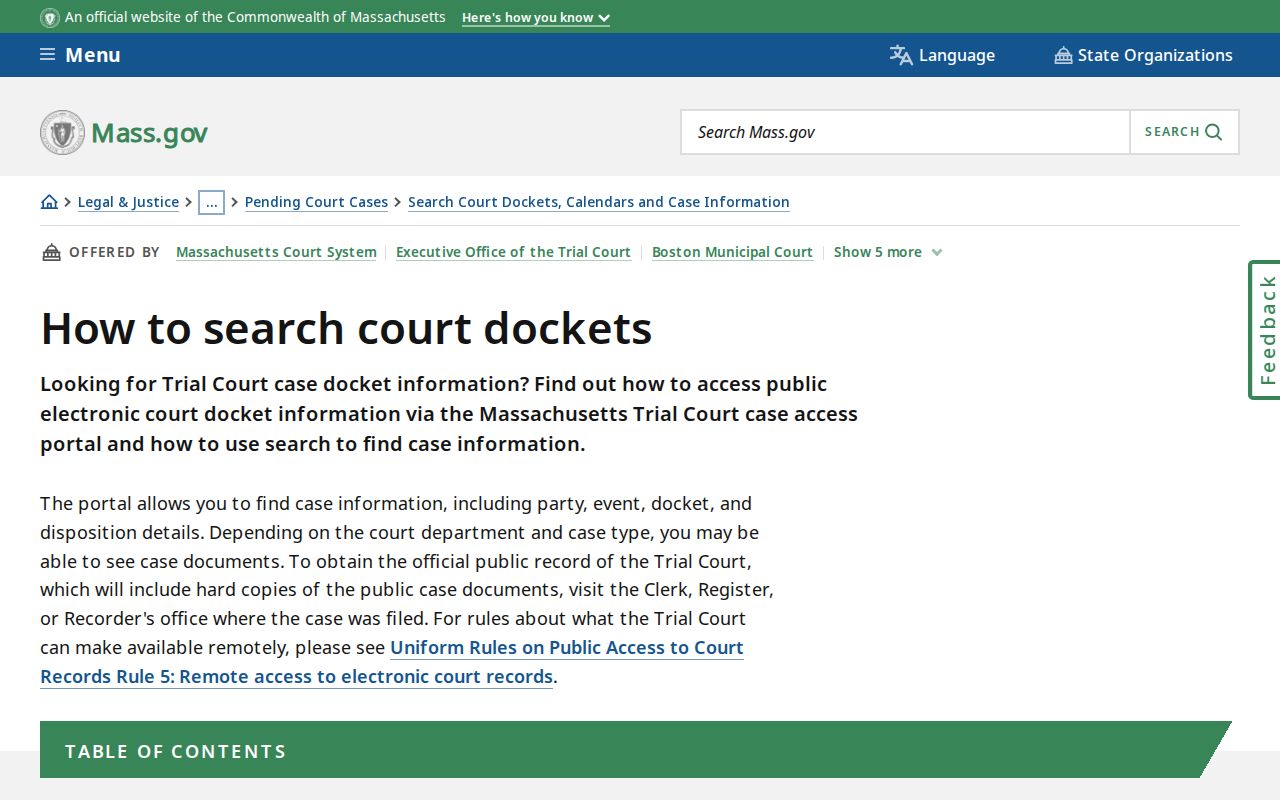
Use the displayed docket fields to distinguish people with the same name before asking the clerk about a file.
Easton Records Request Fallback
When a needed town-held record is not online, direct the request to the department that keeps it and describe the address, record type, date range, preferred delivery format, and contact information. Massachusetts M.G.L. c.66 §10 generally calls for a response within 10 business days. The state guidance allows a request to seek a fee estimate and electronic delivery. It does not require a requester to ask an office to create a new analysis.
Easton Police accepts requests by email, mail, or in person through its records process; the Building Department’s historical information-request form is a more property-specific route. These channels can return records subject to exemptions, redaction, availability, and applicable fees. Narrow requests make it easier to locate an existing map, permit, report, or file.
Consult the Massachusetts request guidance before sending a records request.
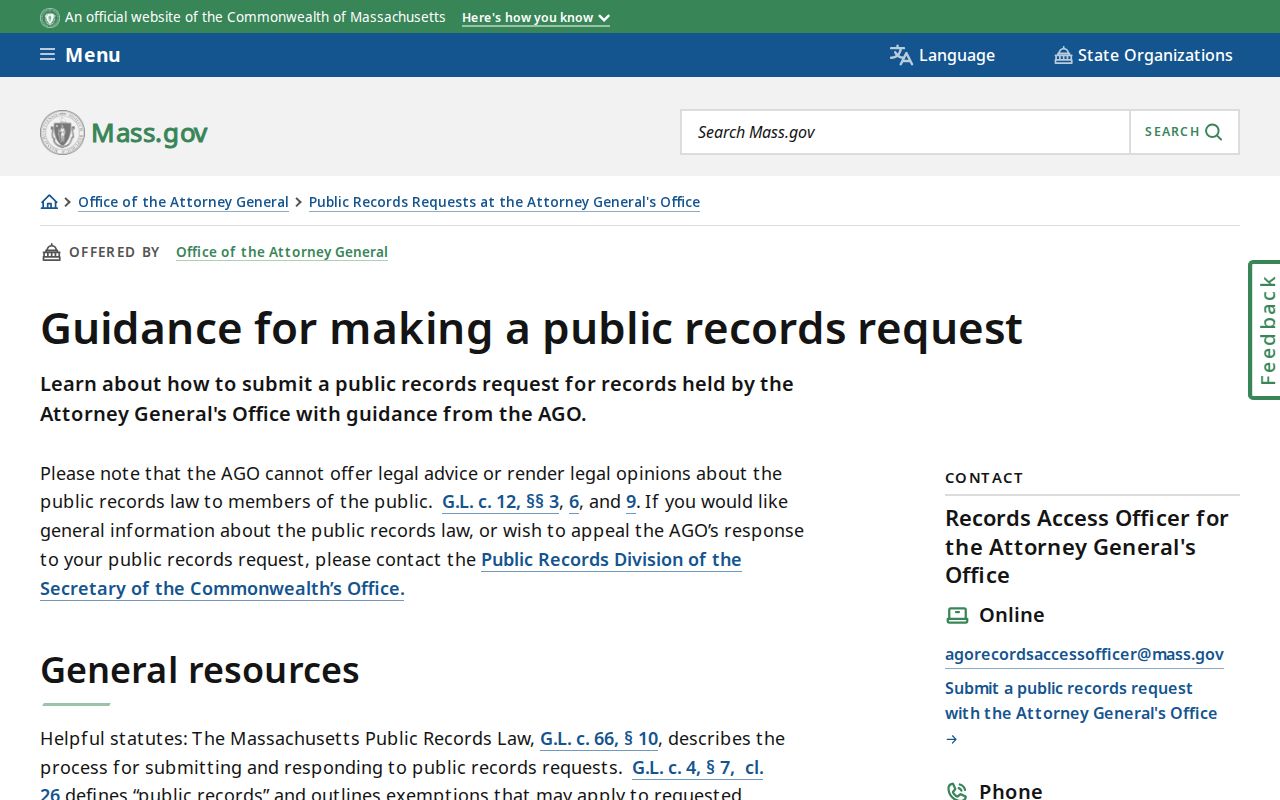
The state guidance helps turn a broad person question into a custodian-specific record request.
Easton Maps, ZIPs, and Addresses
Postal codes are useful search terms but are not town boundaries or proof of a person at an address. Official local sources use 02356 for North Easton and 02375 for South Easton, while 02357 appears for Stonehill College and 02334 in local postal context. Verify every deliverable address with USPS, then use the assessor or Town GIS to confirm parcel jurisdiction. The MassGIS map supports statewide comparison, but it should not replace local parcel evidence.
The Massachusetts interactive map and parcel-data updates can give an additional map view. Easton appeared in May 2025 and April 2026 MassGIS update batches. Record the map date with any observation because parcel layers change.
Open the Massachusetts interactive property map for the statewide map controls.
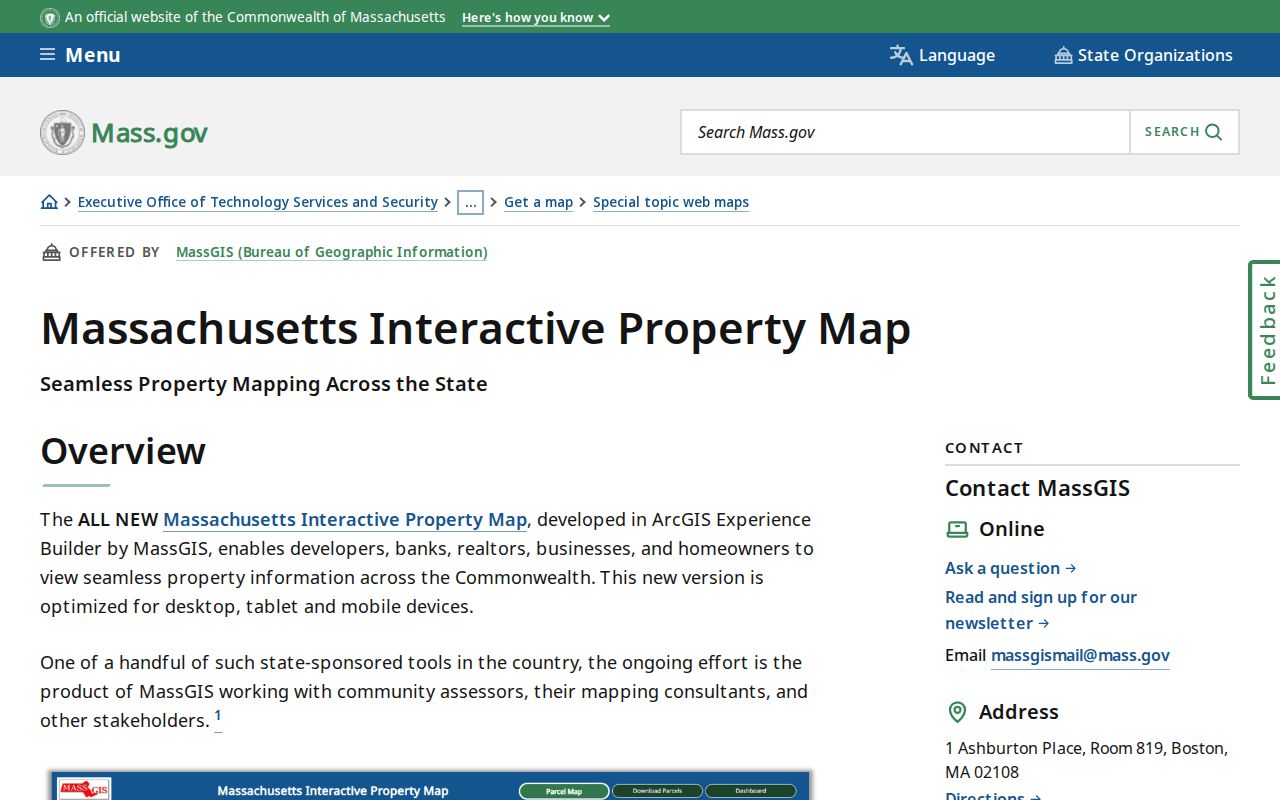
Use a map to compare geography, then return to the Easton custodian for a local property record.
Easton Source Roles Compared
Official records and commercial compiled search products are not the same kind of evidence. An official source lets a researcher see the custodian, date, field labels, and access limits. A compiled result may be old, combine people with the same name, or omit the record role. For family history, estate questions, reconnecting, civic research, or a property question, begin with the official source that owns the record and use another independent category to confirm a match.
| Source type | Strong for | Not proof of |
|---|---|---|
| Property card | Owner and parcel history | Current occupancy |
| Recorded deed | Recorded interest or transfer | Household membership |
| Voter list | Dated registration address | Unprotected current identity |
| Directory or newspaper | Dated historical connection | Modern residence |
Easton Historical Resident Directories
Easton’s verified directory trail is strong but not continuous. The official historic-district report identifies the 1889 Resident and Business Directory for Easton, Mass., published by Local Directory Publishing Co. in Needham. The State Library lists Easton city directories for selected years from 1889 through 1942, while the precise selected-year list still needs a shelf or catalog check. The full collection work belongs on the Easton city directory page.
Ames Free Library’s staff-retrieved Historical Collection, local newspapers, in-library databases, and the Historical Society’s poll and real-estate tax books for 1853–1960 extend the search beyond a single printed volume. The Historical Society also points to town reports, cemetery material, neighborhood collections, and a photo collection searchable by street, individual, or business. Easton’s 2025 tricentennial oral-history project adds useful context, but oral history should be cited as community history rather than legal proof of residence.